Stanford Women's Soccer is playing Boston College tonight. If you don't have a ticket or can't make it down to Stanford, NCAA.com is streaming the game FOR FREE. Click Here. (Or HERE and find "LIVE WEBCAST")
Enjoy.
Stanford vs Boston College - Friday @ 7pm WEBCAST

GOTM Winner - October
And the Winner is.......
Goal #8 - Chelsea doing their best EA FIFA 2010 impression. (My new favorite part about this goal is how Frank Lampard looks over his shoulder to see Drogba when the ball goes past him. That's all it took. It's such brilliance. Put it on full screen and look for the head-on-a-swivel action @ the 16 sec mark.)
The winner.... For the second time... Troy.
You get to choose. $25 at Kombat or Soccer City.
No Practice Next Week
There will be no practice the week of November 23 (We still have Futsal on Sunday Nov 22nd). Sorry for the late notice.
We will resume training on November 30.
I would recommend players attempt to stay fit by hitting the park and spending time with the ball or doing some running on their own.
Have a wonderful holiday!
GameNotes: 11/21 vs San Juan White
Sac United eXtreme 1 - 3 San Juan White:
Loses like this are tough to except.
I think the most difficult thing to take from Saturday's defeat against San Juan is that we were the better team and we lost the game. We were in front and had chances to score the second goal and got punished on three goals. It is beyond belief.
Overall I would like to keep the positives of the game for the girls. Our buildup play and passing from the backs to the midfield was enthusiastic, inventive & very effective. What we lacked today was the killer instincts in the final third: the soccer ideas, the creativity & the execution to get behind the D, carve open a chance and finish.
I think all three goals they scored were soft for us to concede. We as a team must continue to search for the mental strength to fight off these mistakes, not panic & see these games through to the victory.
On a positive note, our roster is regaining full strength. T & Inessa have begun the last phases of their recovery and should be back by our next matches with Gabby to follow shortly after.
Thanks for your continued support.
One Club! One Love!
Easiest Way to Score: World Cup Qualifying Edition
The Cut-Back cross is the easiest way to score from open play in soccer.
Here is another example from today's World Cup 2010 Qualifying. Ireland were down after the first match last Saturday which they lost 0-1 in Ireland.
They needed an away goal in France to even it up and under the such pressure this is how they scored to even the series...
**Update**
But Ireland go out! France are through to WC 2010! All thanks to another cut-back cross (and not one but two handballs by Thierry Henry in the same play) Incredible!
It's a cruel game sometimes!
GOTM
Get your GOTM votes in by this Saturday November 21 to be eligible for the $25 gift cert to Kombat Soccer.
Make sure to leave a COMMENT with your name & your favorite goal number.
Goalkeeping: Angles
Angle play: This area alone separates the pretenders from the contenders. By simply taking up the right position you can make goalkeeping look very easy.
-- Tony DiCicco, Goalkeeper Soccer Training Manual
Here is a good quick read about Goalkeeping from JB Goalkeeping a decent resource for all things GK related.
Along with footwork and good catching skills, positioning provides the foundation of good goalkeeping. A keeper who is always in position makes it look like every shot goes right to them, because the shooter has nowhere else to put the ball. Poor positioning leaves vast areas of net for a shooter, or even an empty net.
Basic Positioning Principles
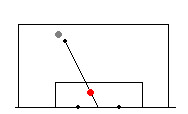 Fig 1. The Center Line Position |
 Fig. 2 Covering the Angle |
First, to position themselves accurately, the goalkeeper must know where the goal is! It sounds obvious, but during the scramble of a game a keeper can lose track. When the play starts moving towards the goal,  the first thing the keeper must do is check the posts to make sure they are starting off with good position. Then, whenever they can divert their attention for a split second, they should check the posts again to make sure they've maintained that good position in the face of a moving ball.
Second, the goalkeeper must always try to position themselves on an imaginary line that runs from the center of the goal to the ball (Fig. 1). This puts them in position to get to either post equally well. The center line determines the side-to-side positioning.
Third, the goalkeeper must position themselves far enough off the goal line to cover the angle created by the ball and both posts. They should be able to cover either post with a couple of quick steps (footwork!) and a dive if necessary (Fig. 2). The angle and the keeper's ability determine the forward/backward positioning.  Many young or timid goalkeepers tend to stay very close to the goal line - sometimes right on it. They must be taught to come off the line if they are to cover any shots near the posts.
How far out a keeper must come depends on their size and ability - smaller goalkeepers or keepers with a poor range will need to come farther out to be able to cover the entire angle.
But don't forget the third dimension not represented in these pictures: height. A keeper who is far off their line is more likely to be beaten by a chip over their head, so that must also be put into the equation. The keeper must adjust the forward/backward position so that they're confident they won't be beaten easily over the top.
Positioning Around the Goal
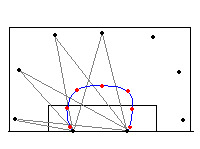 Fig. 3: The Goalkeeper's Arc |
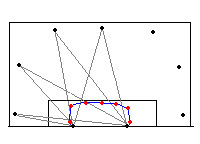 Fig. 4 Adjusted Arc |
Tony DiCicco calls this concept the "Arc Angle". It can easily be demonstrated on the soccer field with three ropes about 50 feet long, one attached to each post and one to a stake at the middle of the goal line. Place the ball at varying spots around the penalty area and have the keeper find their position, then place a cone there. When the exercise is finished, the cones will show that keeper's arc as in Figure 3. Adjust for chip shots and you'll end up with the keeper's arc as in Figure 4.
A keeper should learn this arc and use it as a general guideline for how they position themselves as the ball moves. Notice that this arc roughly follows the goal box. Make sure the keeper notes how their own arc matches or differs from the goal box, so they can use the goal box as a reference during practices and games. However, do not let a keeper, especially a young one, think they must move along this arc at all times. If the ball quickly changes position, they must move as quickly as possible to cover the new position, cutting across the box if necessary.
Also, remember a given keeper's arc will change as they gain size, strength and ability. You may want to run the exercise with the ropes once a season to see if their arc has changed.
Positioning Within the Penalty Area
Discussion of where the goalkeeper should be in the penalty area when the ball is elsewhere on the soccer field is in the tactics section.Quick Summary - Positioning: | Mistakes to Watch For: | ||||||||
|
|
 Know the location of the goalposts
 Not checking the goalposts frequently
Continue Reading
Subscribe Now - RSS

All Content NK and SU eXtreme United U14G